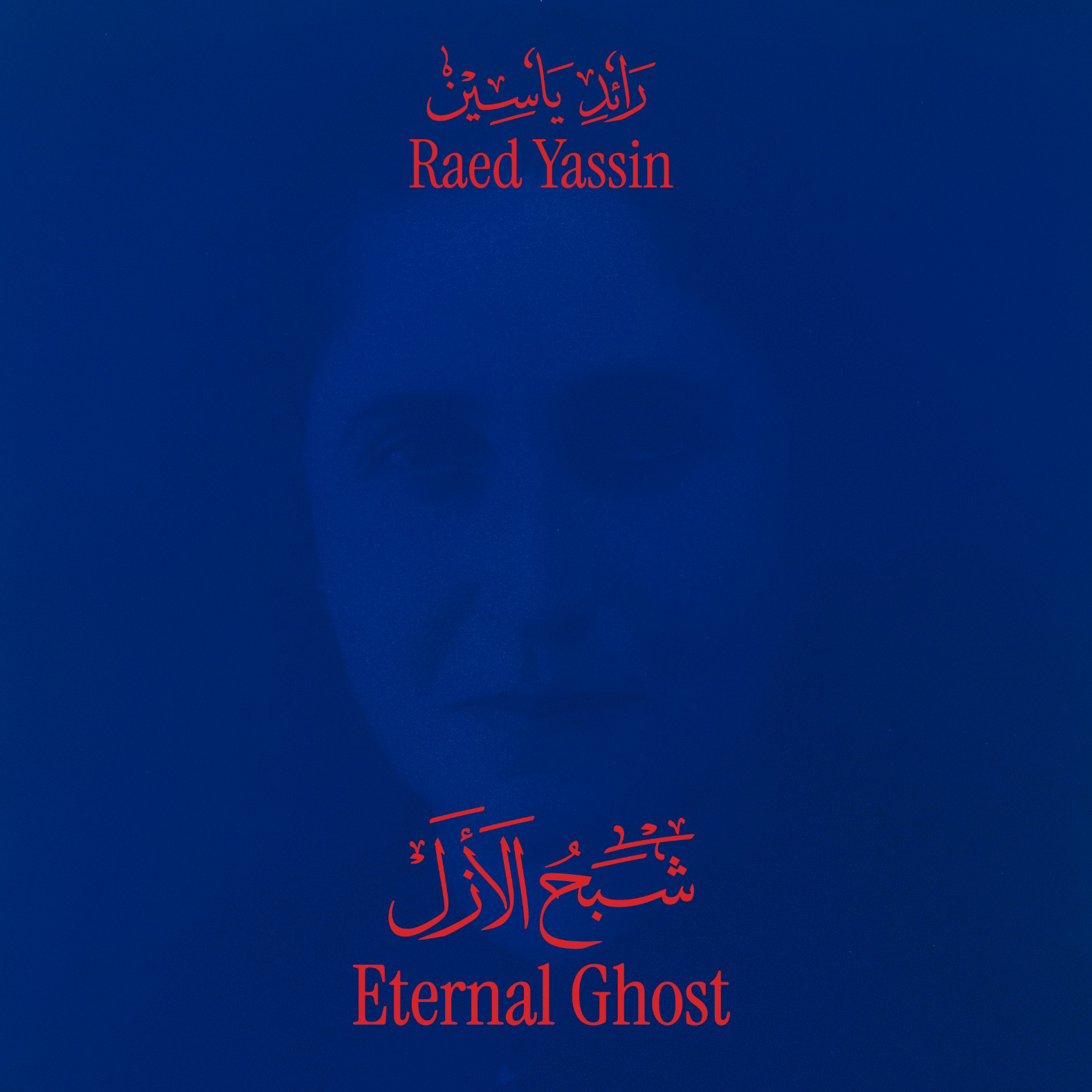
RAED YASSIN
Eternal Ghost
Info
| A Spectre Of A Stranger | 15:52 |
| Eternal Ghost | 16:13 |
Raed Yassin: Synthesizers, Drum Machines, Electronics, Piano, Vocals
Recorded and mixed at Morphine Raum Studio in Berlin by Rabih Beaini
Mastered by: Rashad Becker at Clunk Studio in Berlin
Produced by: Raed Yassin
FOURTH SOUNDS
FS006
Description
Issued to coincide with Yassin’s debut London exhibition of the same name, ‘Eternal Ghost’ is the latest iteration of his decades-long artistic thrust toward consolidating improvised and composed musics. Concrète yet ephemeral, minimal yet majestic, the results diverge and contrast in their outlooks and formations with a guile that has served Yassin well thus far, from a memorable 2009 solo debut of illbient collage for Annihaya Records, to jams with Alan Bishop & AMM as part of “A” Trio, and in Praed/Praed Orchestra!, and most the centre of a complex maelstrom for Morphine Records.
Perhaps unusually ‘Eternal Ghost’ frames Yassin mostly solo and left to his own devices for one of their most intimate, if widescreen, expressions of self. ‘A Spectre of a Stranger’ creeps crepuscular with modular synth evoking onset of night before his synth leads tear at the sky in Riley-esque ribbons layered with wholehearted wail in a compelling forward tilt. The B-side ‘Eternal Ghost’ also charges the metaphysical thru synthetic means with its initial lift of saccading arps knotting into panel-beaten industrial pulse and epic pop vox vamps that switch from fourth world optimism to more ragged no wave dystopia, or the other side of the same wave?
From BOOMKAT product review
Liner Notes by Anton Spice
I first hear Eternal Ghost on a white label test pressing, housed in a white paper sleeve, inside a white cardboard cover. No context. No notes. No history. An object with nothing to identify it. Nothing but sound, and sound is as clear as smoke.
Silence, and then a ticking rhythm, distant at first. Then a melody, synthetic, wavering, revealing its current, its circulation. It repeats, slowly and then almost without warning, tumbles into the abyss. Pulsing, insistent. Over and over and over and over. It takes on a life of its own, oscillates wildly, propagates in new directions. I can no longer keep up, and so let it go and listen as it takes flight, leaving meagre descriptions in its wake.
“Describing something is like using it,” Olga Tokarczuk writes, in a phrase I have always felt applied to writing about music. “It destroys; the colours wear off, the corners lose their definition, and in the end what’s been described begins to fade, to disappear.” Perhaps, to borrow from the title of the first track, it becomes a spectre of itself. A thing erased by interpretation.
And yet, the temptation when faced with something empty is to fill it. To hear movement and pin it to meaning. To read it like a set of signs or a code. To place it in a context. In a genre, an oeuvre, a moment in time. There is always a context.
It is tempting to hear in the fluttering arpeggios of ‘The Spectre of a Stranger’ and ‘Eternal Ghost’ the abject sounds of war, of blood rushing, of projectiles whistling through the dark night.
It is tempting to hear in the word “drone” not the roots of minimalism but the branches of techno-industrial conflict. Techno and industrial - two genres with etymologies that destroy more than they describe.
Edward Said wrote of the “normalized quiet of unseen power”, and yet now it seems all we have is a normalized noise of open destruction. On ‘Eternal Ghost’, the synths drone and the drums beat down in sonic booms.
But perhaps this is too literal, and Raed Yassin rejects the literal. Listening to Eternal Ghost for the first time, I wonder if I have fallen into the trap of describing - of proscribing - meaning. Have I fixed this work with a subjectivity that will destroy its potential for multitudes? Or is the context simply so stifling that it becomes impossible - irresponsible - to hear anything else?
I think instead a little more about arpeggios. Arpeggios are chords, dissembled. In the breaking down of a chord into its component parts, the arpeggio stretches out and multiplies a whole into a sequence, it splinters outcomes into processes. An arpeggio is a fragmentation, an obfuscation. It is a chord used and repeated, until it begins to disappear.
There is a fearsome energy, a sense of bursting through, of catharsis and release to the arpeggios of Eternal Ghost. And yet, on first listen the words I scribble down in my notebook are tighter, more constricted. Claustrophobic. Nowhere to run, nowhere to escape to. In German, the verb verswinden means both to disappear and to flee.
In Lebanon, where Yassin was born, a cycle of war makes return impossible. Online, where we all now reside, the dissonance between suffering and apathy is so great that images are no longer seen but seen through. Patterns repeating, over and over, leading nowhere. Where can you go if human rights, or the right simply to exist, are afforded some and not others?
Eternal Ghost takes a new direction from Yassin’s last solo project Archeophony, his history of turntablism and sonic collage, his free improv group “A” Trio, and his rambunctious Arabic pop outfit Praed. He says this is the only way he can work. Do something new. Experiment. Resist interpretation. Break yourself down into component parts. Splinter outcomes into processes. Arpeggiate. Never resolve. Become a spectre of a stranger in a world that won’t let you rest.
The exhibition with which Eternal Ghost shares its name continues Yassin’s interest in personal and collective memory, and that which is explored in The Company of Silver Spectres. The photos of other people’s lives he collects – of births, marriages, deaths – speak of the histories lost during the Lebanese Civil War. By painting over them in monochrome he says he is bringing them back to life, reanimating the image and the viewer in the act of looking. Yassin describes making the work as meditative, addictive. A ritual that resurrects. A meditation on the phantoms in our midst.
I am reminded of Tina M. Campt’s Listening to Images, in which she suggests that we look as we might listen, to go beyond the descriptive to hear the subtext, the untold history, the emotional registers of an image. “Attending to their lower frequencies,” she writes, “means being attuned to the connection between what we see and how it resonates.”
And so I look at the white label, the white sleeve and the white cover in my hands, and let it resonate too.
The music is maximalist. Ostensibly, at least, it is trying to be heard. And yet the voices which hover ominously above and around both tracks are like shadows, disembodied to the extent that they become textures of sound. Ghosts in the machine. I listen closely, strain to hear words I cannot understand. Could Eternal Ghost in fact be an exercise in listening to that which is accelerating towards the void?Yassin’s longform compositions – born from a background in improvised music, in music that resists commodification – also demand more from the listener. They demand, as minimalism always has, attention at multiple scales. The sense of different frequencies coalescing and falling apart, of train lines running at different speeds, coming together and splitting off. Music that erases in order to reveal.
“The process of capturing the ephemeral and fixing it, is actually the first day of its death,” Yassin says. I listen as a shape emerges from the smoke. It is the shape of something yet to come, that may have already long departed.
Biography
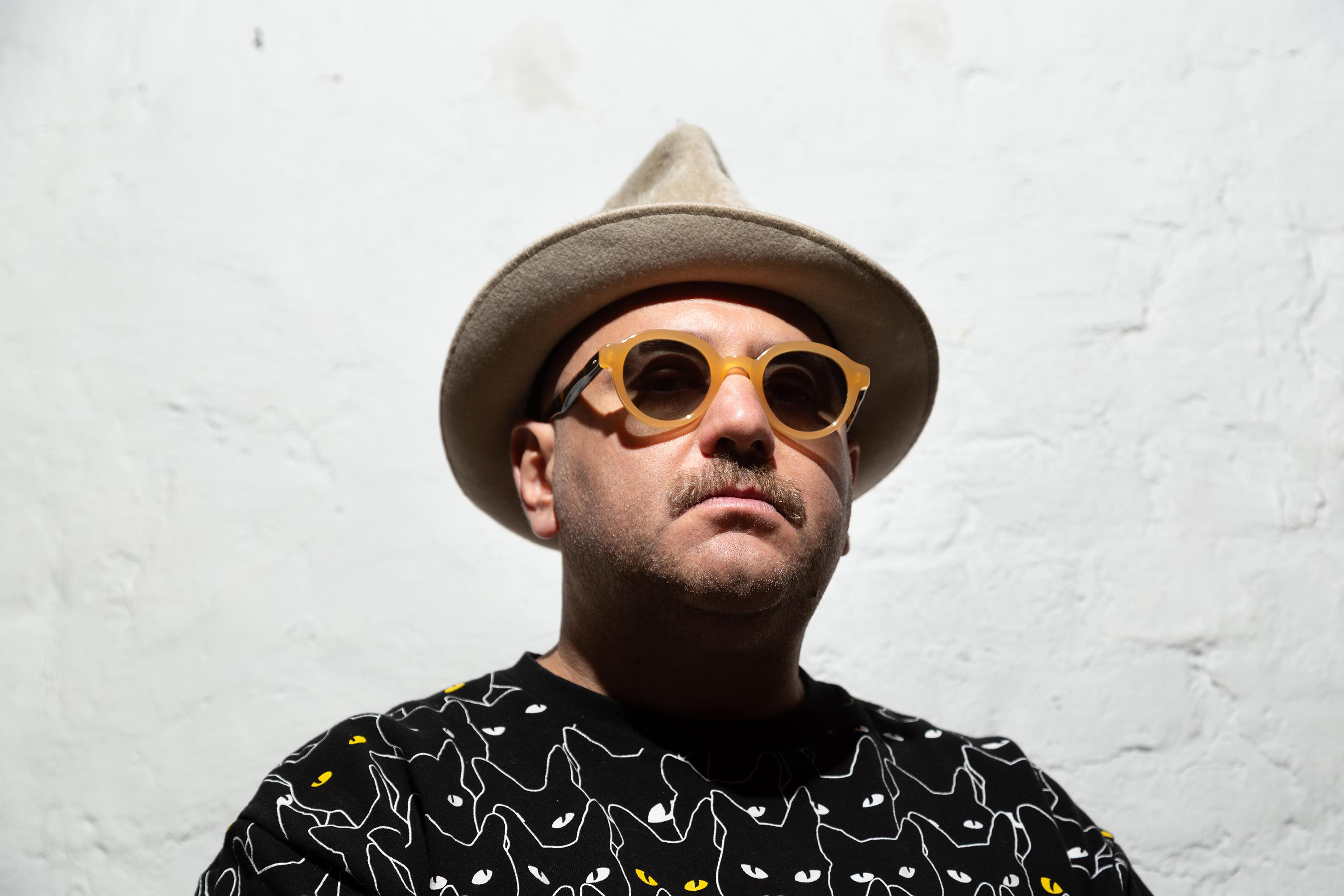
Photo by Tony Elieh
As a musician, Raed Yassin has been a key member in the Lebanese underground music scene for many years. One of the organisers of the Irtijal Festival of Experimental Music from its early beginnings, he founded his concept music label Annihaya in 2009. He is a member of several bands and groups, including “A” Trio, PRAED among others. As a double bassist, he developed a personal and independent extended technique, by employing different preparations and objects on his instrument. His interest here relies heavily on textures, energies and vibrations, the density of volume and sound, rather than conventional melodic structures.
Also an electronic musician and experimental turntablist, his approach to vinyl ranges from deconstructing Arab pop music, to reexamining the traditional music archives of countries from the global south.
With his duo band PRAED (along with Paed Conca), he acts as the lead singer and synth player, merging free jazz with psychedelic rock and Egyptian Shaabi music.
Soundcloud
Youtube
Back to Top